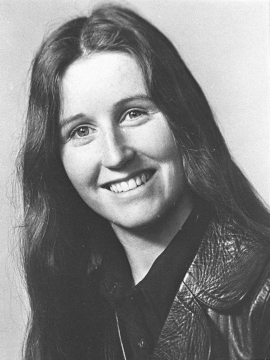
Born: 3 March 1957, Belfast Died: 6 March 1988, Gibraltar (shot dead by the SAS) Organisation: Provisional Irish Republican Army (IRA) Role: Volunteer; Officer Commanding, republican women prisoners, Armagh County: Antrim (Belfast) Buried: Milltown Cemetery, Belfast
Mairéad Farrell was the best-known woman in the Provisional IRA of her generation, the leader of the republican women prisoners in Armagh Gaol, and one of three unarmed IRA members shot dead by the Special Air Service in Gibraltar in 1988, killings the European Court of Human Rights later found to have breached the right to life. Articulate, committed and self-possessed, she became in death one of the foremost symbols of women’s part in the republican struggle.
Early life and the IRA. Mairéad Farrell was born in Belfast on 3 March 1957, the only girl in a family of six. (This date is given by the republican roll of honour Tírghrá and by contemporary sources; the Dictionary of Irish Biography gives 3 August 1957.) She came from a republican family, her grandfather, John Gaffney, having fought in the War of Independence and been interned in 1920. A pupil at Rathmore Grammar School, she was, by a schoolfriend’s account, a brilliant student for whom examinations held no difficulty; but she had thought deeply about the direction of her life, and on finishing her O-levels she left school and joined the IRA, at the age of eighteen.
The Conway Hotel operation and imprisonment. In 1976 Farrell took part in the bombing of the Conway Hotel at Dunmurry, outside Belfast, a venue used by the security forces. During the operation a comrade, Volunteer Seán McDermott, was shot dead by the RUC; another of the three Volunteers involved was Kieran Doherty, who would himself die on hunger strike in the H-Blocks in 1981. Farrell was arrested and convicted of explosives offences and, refusing to recognise the court, was sentenced to fourteen years. She was the first woman imprisoned after the British government withdrew political status in 1976, and in Armagh Prison she took part in the no-wash protest.
Officer Commanding in Armagh. Farrell’s intelligence and force of character quickly made her Officer Commanding of the sentenced women republican prisoners in Armagh, a role she insisted carried no glamour: there were, she said, “no kudos in it”, and the decisions she took affected every prisoner, leaving her at times feeling very alone.
The hunger strikes. On 1 December 1980 Farrell, with Mary Doyle and Mairéad Nugent, joined the first hunger strike, the three women in Armagh fasting in support of the men in the H-Blocks; they ended their fast on 19 December, the day after the H-Block strike was called off. When a second hunger strike began in 1981, Farrell, again Officer Commanding, presided over the agonising decision that the Armagh women would not join it, and through the long months of the strike and the deaths of the ten men she worked to sustain the morale of the prisoners around her and to negotiate visits for women with relatives in the other jails. It was, she said, “the worst time in prison. Waiting for the deaths.” While still serving her sentence she had stood as an Anti H-Block candidate in the Republic’s 1981 general election.
Release and activism. In her later years in Armagh, Farrell took Open University courses in politics and economics. Released in September 1986 after ten and a half years, she was accepted by Queen’s University Belfast to read for a degree in the same subjects. She threw herself at once into the campaign against the strip-searching of women prisoners, speaking at meetings across Ireland, and she returned to active service with the IRA, saying that imprisonment had only strengthened her resolve. She was an articulate exponent of a republicanism that fused the national, social and women’s questions: she described herself as a socialist and a republican who believed in a united, socialist Ireland, and argued that the liberation of women was inseparable from the liberation of the country, insisting that women must be actively involved so that “what happened after 1916”, when women were pushed into the background, should not happen again. She was clear-eyed about the likely cost, reflecting not long before her death that a Volunteer would ultimately end up dead or in prison, and that one could not run forever.
Gibraltar. On 6 March 1988 Farrell travelled to Gibraltar with Daniel McCann and Seán Savage as part of an IRA active-service unit that British intelligence believed was preparing a car-bomb attack on a military ceremony. All three were unarmed when soldiers of the SAS shot them dead on a public street, in the operation codenamed Flavius. The official account, that the soldiers believed the three were about to detonate a device, was disputed by eyewitnesses and examined critically in the Thames Television documentary Death on the Rock. In 1995, in McCann and Others v United Kingdom, the European Court of Human Rights ruled that the killings had breached Article 2 of the European Convention on Human Rights, the right to life.
Funeral and legacy. Farrell was thirty-one. Her funeral at Milltown Cemetery on 16 March 1988 was attacked by the loyalist gunman Michael Stone, who killed three mourners. A committed feminist and socialist as well as a republican, she became one of the most enduring symbols of the women of the IRA, commemorated in murals on the Falls Road, in film, and in annual commemorations; a biography drawing on the interviews she had given was in preparation at the time of her death.
Related Sections:


Selected Documents:


Sources:
- An Phoblacht/Republican News, tribute to Vol. Mairéad Farrell, 10 March 1988 (held in the archive).
- Tírghrá: Ireland’s Patriot Dead (National Commemoration Committee, 2002), entry for Mairéad Farrell.
- “Farrell, Mairead,” Dictionary of Irish Biography.