
The executions of Easter Week had done what years of organising could not: they made republicans of a generation. Between 1917 and 1923 Ireland passed through the most convulsive period in its modern history, the reorganisation of Sinn Féin and the Volunteers, the landslide of 1918, the declaration of the Republic, and a guerrilla war that brought the British Empire to the negotiating table. Yet the revolution would not be completed.
The Treaty of December 1921, signed under duress and threat of overwhelming force, partitioned the country and demanded an oath of allegiance to the Crown. For those who had fought for an Irish Republic, it was not a stepping stone but a surrender, the abandonment of the Republic proclaimed in 1916 and ratified by the Irish people in 1918.
The Civil War that followed pitted former comrades against one another, with the Free State, armed by Britain, suppressing the republican resistance through internment, executions, and force. By May 1923 the IRA had dumped arms, but the Republic had not been established. For the republican movement, the period ends not in triumph but in unfinished business, a betrayal whose consequences would shape Irish politics for the rest of the century.
1917
The political landscape shifts rapidly in the aftermath of the Rising. A succession of by-election victories announces the emergence of a reconstituted Sinn Féin as the dominant force in nationalist Ireland, while surviving internees return from Frongoch to rebuild the Volunteer movement on more determined foundations.


1918
The threat of conscription unites nationalist Ireland in opposition to British policy and drives mass radicalisation. The general election of December produces a republican landslide, with Sinn Féin winning 73 seats on an abstentionist platform, a mandate, republicans would always insist, for an independent Irish Republic.


1919
The First Dáil assembles in January, ratifies the Republic, and issues its Declaration of Independence. Simultaneously, the Irish Volunteers, soon to become the Irish Republican Army, begin the guerrilla campaign that will define the following two years, with the ambush at Soloheadbeg marking the opening shots.


1920
The War of Independence intensifies on all fronts. Crown forces respond to IRA activity with reprisals that radicalise civilian opinion further, while Bloody Sunday in November brings the conflict to international attention. The Government of Ireland Act partitions the country, giving institutional form to the Orange statelet in the North.


1921
A truce in July halts the fighting, and negotiations follow in London. The Treaty of December, signed under British ultimatum, concedes partition, demands an oath of allegiance to the Crown, and falls far short of the Republic for which republicans had fought. Its acceptance by a narrow Dáil majority fractures the movement.
 Ná Bac Leis No 1 (September 1921) |  The Testament of the Republic – Éamon de Valera (1921) |  The Struggle of the Irish People |
 Irish Self-Determination League Of Great Britain Public Meeting Leaflet (1921) |
1922
The Treaty is ratified and a Provisional Government established, backed by British arms and money. Republicans opposed to the Treaty maintain their allegiance to the Republic and to the IRA’s Army Executive. The outbreak of Civil War in June marks the point at which former comrades take opposite sides, with the Free State forces attacking the Four Courts garrison.


Poblacht na h-Éireann war news (1922-1923)
The republican movement’s daily bulletin during the Civil War, published continuously from the outbreak of hostilities in June 1922 through to early 1923. Produced under increasingly difficult conditions as Free State forces gained the upper hand, Poblacht na hÉireann War News serves as an indispensable primary source for the republican experience of the conflict — recording military communiqués, political statements, and the movement’s unflinching determination to maintain its claim to the Republic in the face of overwhelming force.


1923
The Free State pursues the Civil War with a severity that shocks even some of its own supporters, executing seventy-seven republican prisoners without trial, interning thousands more. Frank Aiken’s order to dump arms in May ends organised resistance, but the Republic remains unestablished and the republican movement, though defeated militarily, remains unbowed in its principles.


Misc
Undated or unattributed documents from the period that cannot be assigned to a specific year, including election material, commemorative items, and ephemera. While these items resist precise dating, they remain valuable primary sources reflective of the broader political and cultural life of Irish republicanism during the revolutionary period.


Reference Tools


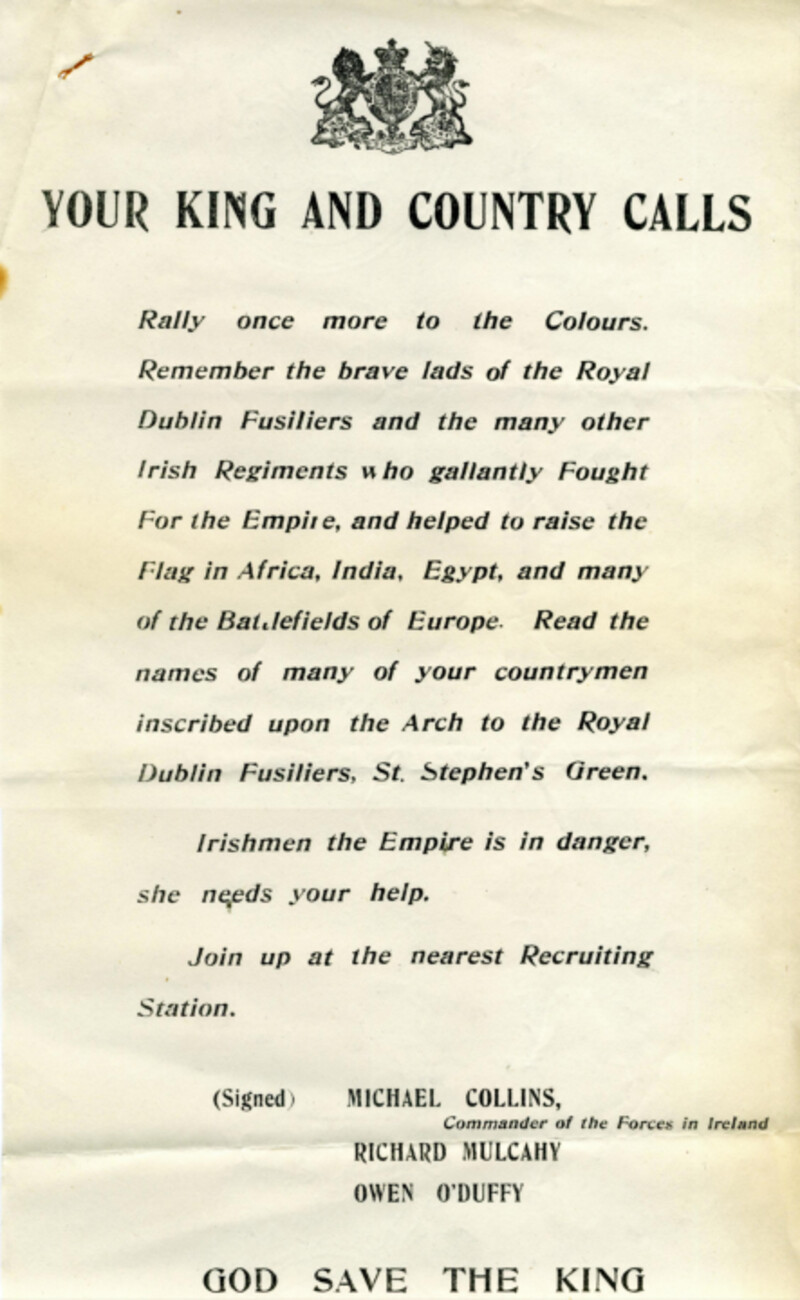
(1) Donated by Brian Hanley
(2) Donated by Irish Election Literature
© Irish Republican Digital Archive. Historical documents are presented for educational and research purposes only. We do not endorse or promote any views expressed in the material. Some content may be politically or historically sensitive. [Read full disclaimer]