The Irish republican struggle was never understood by its supporters as a purely local affair. From the nineteenth century onward it was presented as one front in a wider contest against the British Empire, and later against imperialism in general, and that framing won it sympathy far beyond Ireland and the Irish diaspora. During the Troubles in particular, solidarity groups, left-wing parties, and prisoners’ campaigns took up the cause across Europe and beyond, drawing parallels between the conflict in the North and their own national or revolutionary struggles.
The material gathered here records that international dimension: newspapers, bulletins, posters, and pamphlets produced in more than a dozen countries, most of it during the 1970s and 1980s and much of it in languages other than English. It ranges from the organised solidarity movements of West Germany and France to a lone tribute or translated text from further afield, and it reflects both genuine grassroots activism and, in some cases, the use of the Irish question by states and movements pursuing purposes of their own.
Basque Country
Of all the European movements, the Basque abertzale left felt the closest kinship with Irish republicanism, seeing in it a mirror of its own campaign for independence from a larger state. The two struggles were frequently linked in Basque radical publications, several of which are represented here.


France
French support was small but intellectually active, centred on Paris and on circles close to the universities. It produced a steady stream of translated analysis and solidarity papers such as Irlande Libre and Solidarité Irlande, and was the setting for the affair of the “Irlandais de Vincennes,” three Irish republicans whose arrest in 1982 grew into a notable French political scandal.
1970s


1980s
 Irlande Libre no. 9 (November 1980) (1) |  Irlande Libre no. 34 (Dec 83-Jan 84) (1) |  Irlandais Vincennes Asylum Leaflet (1) |
 H Block French Poster (1980) |  Solidarite Irlande (1982) |
1990s
 Solidarite Irlande no 13 (July-August 1994) (1) |  Solidarite Irlande no 22 (Autumn 1996) |  Solidarite Irlande no 24 (Summer 1997) |
2000s
 Tiocfaidh ar La (January 2005) |  Tiocfaidh ar La (2003) |  Tiocfaidh ar La (May 2005) |
 Tiocfaidh ar La (September 2004) |
Germany
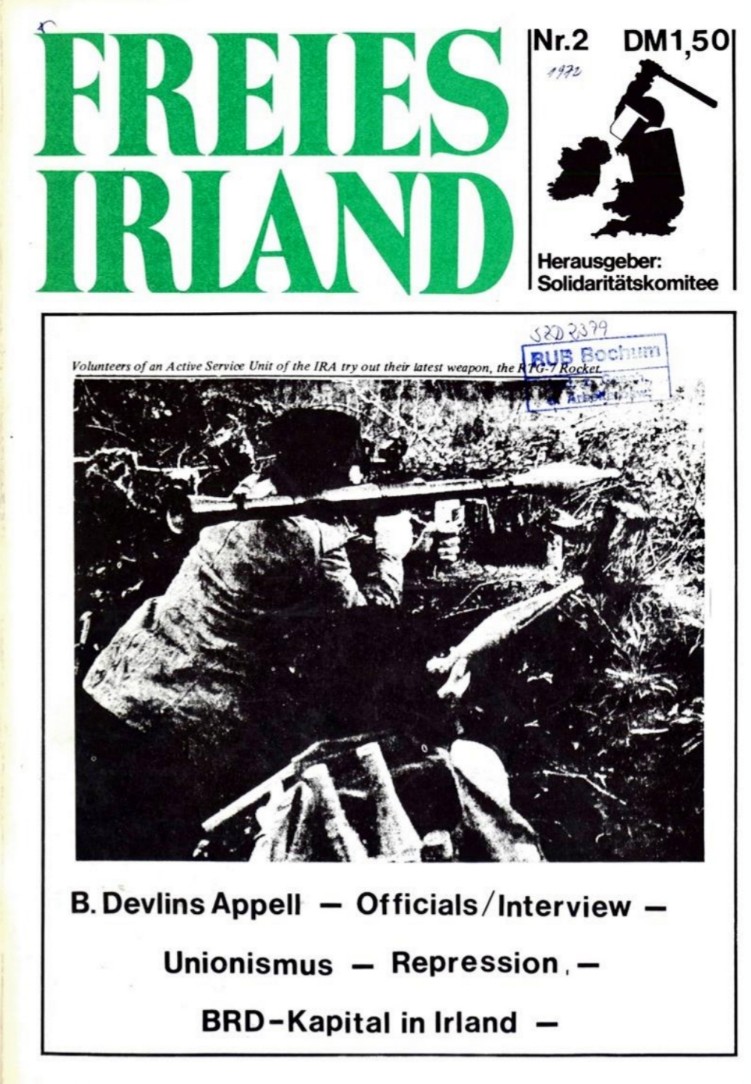
West Germany hosted the largest and most organised of the continental solidarity movements, closely tied to the radical and anti-imperialist left. Its groups produced papers such as Freies Irland and Ireland Solidarity Info, campaigned around the British Army of the Rhine stationed on German soil, and took some trouble to distinguish the Irish struggle from the armed politics of the home-grown Red Army Faction.
1970s


1980s


1990s


2010s

Holland (Netherlands)
Dutch solidarity was organised largely through the Ierland Komitee and allied groups, which produced Dutch-language bulletins and posters and folded the Irish cause into a broader anti-colonial and political-prisoner activism. Hunger strike and prisoner-release material features prominently.
1970s

1980s


2000s

Sweden
Swedish support drew on the country’s strong tradition of left-wing and anti-imperialist activism, with Trotskyist and Marxist groups producing posters and leaflets that focused on British emergency legislation and the treatment of Irish political prisoners.
 Revolutionära Marxisters Förbund Poster (1972) |  Swedish Poster (1970s) |  Swedish Special Powers Act Leaflet (1970s) |
The Soviet Union
Soviet interest in the conflict was a matter of state rather than grassroots solidarity. Official publications such as the 1977 booklet held here used British conduct in the North of Ireland as material for Cold War criticism of the Western powers and their human rights record

Australia
Australia’s large Irish-descended population gave the republican cause a natural audience, expressed most visibly during the 1981 hunger strike.


Turkey
The Irish struggle, and Bobby Sands above all, held a particular resonance for the Turkish left, whose own prison hunger strikes and death fasts lent his example a special force. He remains a commemorated figure there, as the Turkish edition of his prison writings reflects.

Japan
Japanese coverage was the work of small far-left and countercultural circles, represented here by a 1990s publication that carried news of the conflict to a Japanese readership.

Libya
Libya’s connection operated at the level of the state. Under Gaddafi it offered rhetorical backing and, at various points, material support to the Provisional IRA, and the tribute held here reflects that official sympathy rather than any popular movement.

Belgium
Belgian activists contributed to the wider European solidarity network, principally through anti-internment campaigning, as the poster held here illustrates.

Denmark
Danish solidarity, like that elsewhere in Scandinavia, grew out of left-wing activist circles and is represented here by mid-1970s solidarity material

(1) Donated by https://x.com/TroublsInFrance
© Irish Republican Digital Archive. Historical documents are presented for educational and research purposes only. We do not endorse or promote any views expressed in the material. Some content may be politically or historically sensitive. [Read full disclaimer]
Subscribe to our free newsletter here.