The quarter-century following the Civil War was among the most difficult in the history of Irish republicanism. The movement emerged from that conflict defeated militarily, depleted in numbers, and confronted with a Free State that was consolidating rapidly with British support and the backing of the Catholic Church. The Republic proclaimed in 1916 and ratified in 1918 had not been established — and the two governments that now administered the partitioned island, one in Dublin and one in Belfast, were both products of the settlement republicans had rejected.
Yet the movement endured. Through internment, marginalisation, internal division, and the particular pressures of the Emergency years, republicans maintained their organisation and their allegiance to the unfinished republic. The period closes with the irony of the 1949 Republic of Ireland Act — a twenty-six county republic declared by a former opponent of republicanism, which copper-fastened partition and left the northern state untouched.
For the republican movement it was confirmation, if any were needed, that the national question remained unresolved. The documents in this section reflect the full complexity of these years: the debates, the splits, the campaigns, and the quiet persistence of a movement that refused to accept the settlement of 1921 as the final word.
1924


1925


1926


The IRA that emerged from the Civil War was a diminished but determined organisation. Its members had been imprisoned, killed, or driven into exile, and the Free State showed little inclination toward reconciliation with those who had opposed it. Reorganisation was slow and difficult, carried out against a backdrop of public exhaustion with political violence and a constitutional nationalism that regarded the Treaty settlement as both legitimate and permanent.
The IRA’s Army Council maintained its claim to be the lawful government of the Republic — the inheritor of the Second Dáil’s authority — while debating how best to advance that claim in conditions utterly unlike those of the independence struggle.
The arrival of Fianna Fáil as an electoral force from 1927 onward complicated matters further, offering a constitutional path that drew many former republicans away from the movement while leaving the core unappeased. By 1932, with de Valera on the cusp of power, the IRA faced a pivotal question about its relationship to a constitutional politics that was beginning to speak, however selectively, its language.
1929


1930


1931
 JJ O’Kelly’s (Sceilg) Presidential speech at the 1931 Sinn Féin Ard Fheis. |  Easter Week Commemoration Booklet (1931) |
1932


1933
The early years of Fianna Fáil government brought an ambiguous moment for republicanism. De Valera’s dismantling of some of the Treaty’s more objectionable features — the oath of allegiance, the governor-general, the land annuities — satisfied many who had opposed the settlement, but republicans were clear-eyed about what was not changing: partition remained intact, the twenty-six county state remained the limit of his ambitions, and the IRA remained outside and increasingly at odds with the new establishment.
The period also saw the emergence of the Republican Congress in 1934 — an attempt to marry republicanism with a radical social programme that ultimately split along familiar lines and collapsed within a year. By 1936 the IRA had been proscribed by the very government many of its former comrades had helped to elect, and the movement was navigating an increasingly hostile environment on both sides of the border.


1934

1935

1936

1937
 Wolfe Tone Weekly (20 November 1937) |  Wolfe Tone Weekly (23 October 1937) incomplete |  Wolfe Tone Weekly (30 October 1937) |
 Prison Bars (June 1937) |
1938
De Valera’s 1937 constitution replaced the Free State with a new state — Éire — whose text acknowledged the national territory as the whole island while making no practical effort to reunite it. For republicans it was characteristic: the language of the Republic appropriated in the service of a twenty-six county settlement.
Of more fundamental significance to the republican movement was the decision of the surviving members of the Second Dáil — the last parliament elected on an all-Ireland basis and the only one republicans recognised as legitimate — to delegate their authority to the IRA Army Council in 1938. This act was understood within the movement as the formal transfer of the Republic’s sovereignty to the IRA, providing constitutional grounding for its claim to be the legitimate government of Ireland and its armed campaign the lawful defence of that Republic.
The IRA meanwhile turned outward, launching a bombing campaign in England in January 1939 that reflected both the movement’s frustration and its isolation. The S-Plan, as it was known, brought republican activity to British cities but also hardened attitudes in Dublin and intensified state repression. By September 1939, with Europe at war, the IRA faced a hostile Free State government determined to preserve neutrality at the movement’s expense.


1939


1940
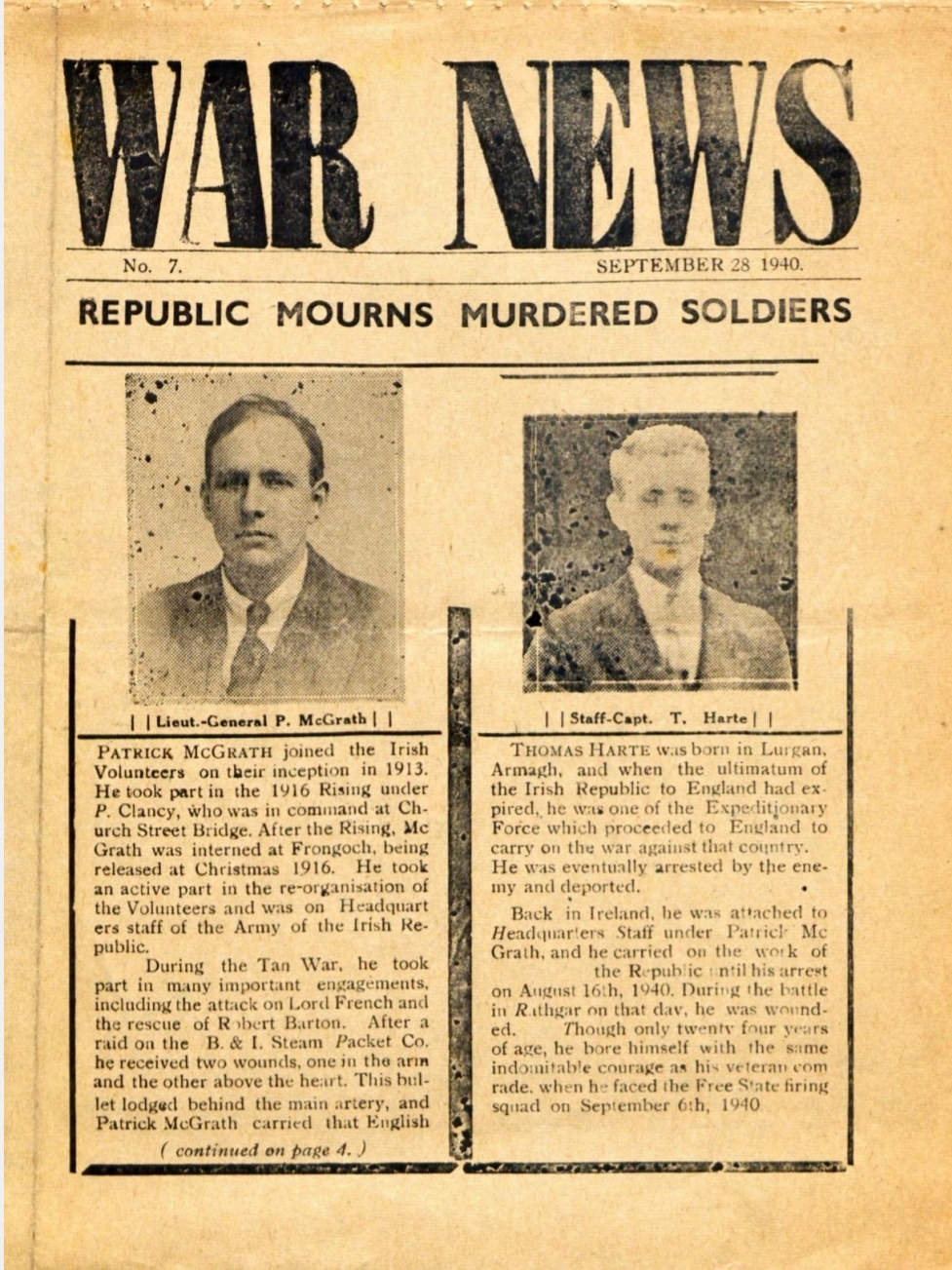
The years of the Second World War — known in the twenty-six counties as the Emergency — were the movement’s darkest since the Civil War. The Irish government interned hundreds of republicans without trial, executed several, and allowed others to die on hunger strike rather than make concessions.
In the North, the Stormont government pursued its own internment policy with equal severity. Caught between two hostile states, starved of resources, and denied any meaningful external support, the IRA was reduced to a fraction of its pre-war strength. The contacts some within the movement pursued with Germany — born of the old principle that England’s difficulty was Ireland’s opportunity — brought further isolation and gave both governments additional justification for repression. By 1945 the movement was at its lowest ebb, its structures damaged and its public support minimal.


1941


1942


1943
 Republican News (March) (1) |  Republican News (April, Belfast) (1) |  Republican News (April, Dublin) (1) |
 Republican News (June) (1) |  Political Prisoners Held by Fianna Fail (June 1943) |
1946
The post-war years brought a slow process of regrouping. Internees were released gradually, organisation was rebuilt, and the movement began to look again toward the North as the central focus of republican activity. The declaration of the Republic of Ireland in 1949 — achieved not by republicans but by an inter-party government led by Fine Gael — produced a complex response within the movement.
The twenty-six county state had formally left the Commonwealth and declared itself a republic, but the six counties remained under British rule and the Ireland Act passed at Westminster in response entrenched partition further by guaranteeing that the North could not be removed from the United Kingdom without the consent of Stormont. For republicans it was a hollow achievement: the name of the Republic without its substance, and a constitutional settlement that closed off rather than advanced the prospect of unity.


1948
 The United Irishman (May) (1) |  The United Irishman (June) (1) |  The United Irishman (July/August) (1) |
 The United Irishman (Oct/Nov 1948) (1) |
Anniversary and Retrospective Documents


Reference Tools


(1) Donated by Colum Ó Ruairc
© Irish Republican Digital Archive. Historical documents are presented for educational and research purposes only. We do not endorse or promote any views expressed in the material. Some content may be politically or historically sensitive. [Read full disclaimer]
Subscribe to our free newsletter here.