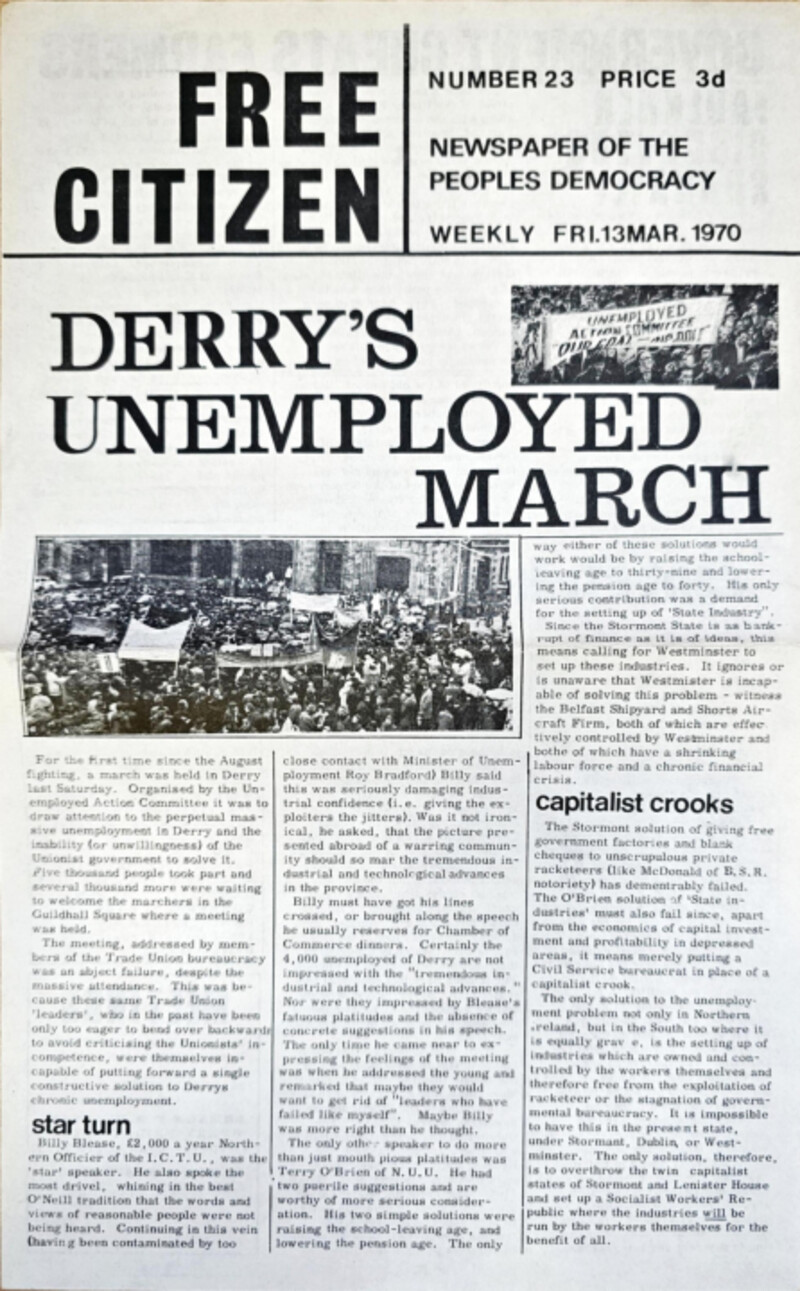
People’s Democracy emerged from the civil rights agitation of late 1968, formed by students at Queen’s University Belfast in the days after the Royal Ulster Constabulary baton-charged a civil rights march in Derry that October. What began as a loosely organised radical pressure group quickly acquired a national profile: its march from Belfast to Derry over the new year of 1969, ambushed by loyalists at Burntollet Bridge, became one of the defining images of the period and helped push the North toward the open conflict that followed.
Though it never commanded a mass membership, People’s Democracy occupied a distinctive place on the Irish left. Across the 1970s it moved steadily from civil rights campaigning toward revolutionary socialism, eventually aligning with the Trotskyist Fourth International, while remaining active in the anti-internment, anti-partition, and prison-protest campaigns that ran alongside the wider republican struggle. Figures associated with it, among them Michael Farrell and Bernadette Devlin McAliskey, kept it visible well out of proportion to its size, and it contested elections in both parts of Ireland before declining and ultimately reconstituting itself as Socialist Democracy in the 1990s.
The organisation’s outlook is recorded most fully in its newspapers, which make up the bulk of this collection: Free Citizen, retitled Unfree Citizen after the introduction of internment in 1971, and later Socialist Republic, together with the magazine An Réabhlóid and a range of pamphlets and election material. People’s Democracy sat to the socialist side of the traditions this archive usually documents, but its concerns overlapped with theirs at almost every turn, and the material gathered here offers a valuable view of that shared ground.
1969


1970


1971


1974


1975

1976


1979

1981


1980s


1990s


Misc


(1) Donated by @irish_republican_archive
© Irish Republican Digital Archive. Historical documents are presented for educational and research purposes only. We do not endorse or promote any views expressed in the material. Some content may be politically or historically sensitive. [Read full disclaimer]
Subscribe to our free newsletter here.